Elevated plus maze test
Labs run this test to measure anxiety-like behavior. This protocol combines how 4 papers ran it in mice.
Quotes from Puech et al. 2025, Liu et al. 2024, Wen et al. 2024 and Rattner et al. 2020
- Puech et al. 2025
“The EPMT was used to assess anxiety behaviors [64,72,73,74].”
“The open arms are considered by mice as a threatening area.”
- Liu et al. 2024
“An elevated plus maze (EPM) was used to measure anxiety effects.”
- Wen et al. 2024
“Tests of open field and elevated plus maze were performed to evaluate anxiety-like behaviors.”
- Rattner et al. 2020
“Spontaneous locomotion was assessed in the open field test, motor learning was assessed in the rotarod test, anxiety-related behavior was assessed in the elevated plus maze, and basic cognitive performance was assessed in the Y-maze spatial recognition test.”
Maze elevation
56 or 80 cm
Room habituation
At least 30 min
Session duration
5 min
- Order in Wen et al. 20242nd of 7 tests
What you need
Sold by ConductScience, which runs this site.
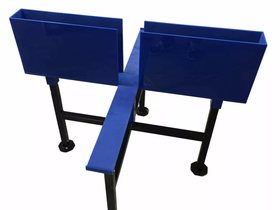
Elevated plus maze
Black, blue, clear, gray or white. Stands 61 cm high.
- Mouse: arms 35 × 5 cm, closed-arm walls 20 cm.
- Rat: arms 50 × 10 cm, closed-arm walls 30 cm.
“All the mazes were purchased from Maze Engineers (Cambridge, MA, USA).”
Maze Engineers is a ConductScience brand.
How to run it
These steps combine what the papers report. AI read the papers and wrote the steps. Software matched every quote to the paper’s text. No person has reviewed this page yet. How records are made
- 1
Raise the maze off the floor
Puech et al. 2025 used 56 cm. Liu et al. 2024 used 80 cm.
Quotes from Puech et al. 2025 and Liu et al. 2024
- Puech et al. 2025
“The device is situated 56 cm above the floor.”
- Liu et al. 2024
“The EPM apparatus consisted of an elevated platform (80 cm above the floor) with four arms (each 30 cm in length and 5 cm in width), two opposing closed arms with 14 cm walls and two opposing open arms.”
- 2
Set the camera and light
Put the camera above the maze. Wen et al. 2024 lit the open arms to 215 lux. The other papers here give no light level for this test.
Quotes from Puech et al. 2025 and Wen et al. 2024
- Puech et al. 2025
“The tests were recorded from a vertical point of view with a video camera suspended above the experimental area.”
- Wen et al. 2024
“The testing room was luminated by an 18″ ring light (Inkeltech) mounted around overhead camera that generates 215 lux of light in the open arms.”
- 3
Habituate the animals to the room for at least 30 min
Quotes from Liu et al. 2024 and Wen et al. 2024
- Liu et al. 2024
“Before the EPM test, mice were brought to the testing room for environmental habituation for at least 30 min.”
- Wen et al. 2024
“All animals were habituated in the testing room at least 30 min before testing starts.”
- 4
Keep the experimenters blind to the groups
Quotes from Puech et al. 2025 and Rattner et al. 2020
- Puech et al. 2025
“The behavioral experiments were performed by operators who were blinded to the exposure and were conducted by three observers between 9 a.m. and 5 p.m.”
- Rattner et al. 2020
“During all behavioral testing, the experimenters were blind to the genotype.”
- 5
Place the animal in the center and record for 5 min
Puech et al. 2025 and Liu et al. 2024 faced the animal toward an open arm.
Quotes from Puech et al. 2025, Liu et al. 2024 and Wen et al. 2024
- Puech et al. 2025
“The animals were placed in the central area facing one open arm and allowed to explore the maze for 5 min.”
- Liu et al. 2024
“Mice were individually placed in the center of the EPM apparatus, towards one of the open arms.”
“The trajectories of the mice were tracked for 5 min, and the time spent in the open arms was recorded with an Ethovision video tracking system V14 (Noldus Information Technology).”
- Wen et al. 2024
“Each animal was placed in the central area then activity was recorded for 5 min.”
- 6
Clean the maze with 70% ethanol
Puech et al. 2025 cleaned it throughout the experiments to prevent odor cues, and does not say how often.
Quotes from Puech et al. 2025
- Puech et al. 2025
“Throughout the experiments, the experimental set-ups were cleaned with 70% ethanol to prevent odor cues.”
- 7
Score time in the open arms
Wen et al. 2024 also scored closed-arm time and counted entries. These papers' Methods do not say what counts as an arm entry.
Quotes from Puech et al. 2025, Liu et al. 2024 and Wen et al. 2024
- Puech et al. 2025
“In our experiments, we considered the open arms as well as the center zone.”
- Liu et al. 2024
“The trajectories of the mice were tracked for 5 min, and the time spent in the open arms was recorded with an Ethovision video tracking system V14 (Noldus Information Technology).”
- Wen et al. 2024
“The time spent and number of entries into the open/closed arms were analyzed by the EthoVision XT 17 system.”
- 8
Read the result
Fewer open-arm entries or less open-arm time means more anxiety-like behavior. Puech et al. 2025 instead read open-arm time as impulsivity and closed-arm time as anxiety-like behavior.
Quotes from Wen et al. 2024 and Puech et al. 2025
- Wen et al. 2024
“Decreased number of entries or time spent in the open arms is indicative of anxiety-like behavior.”
- Puech et al. 2025
“The time spent in the open arms is commonly used as a measure of impulsivity, while the time spent in the closed arms is deemed to reflect anxiety-like behaviors in mice.”
When to run it
Early. Wen et al. 2024 ran it second, after the open field.
No other paper here reports its full test order.
Day 1–2
Elevated plus mazeThis test
Day 5
Three-chamber sociability task
Day 8
Day 10
Barnes maze
Day 21–26, Day 29–34
Day 29–31, Day 36–38
Day 33, Day 40
The last three tests ran in two batches, so each has two bars.
Quotes from Wen et al. 2024
- Wen et al. 2024
“The order of tests was as follows: Day 1–2, open field; Day 5, elevated plus maze; Day 8, three-chamber sociability task; Day 10, rotarod; Day 21–26, Barnes maze for batch 1; Day 29–34, Barnes maze for batch 2; Day 29–31, balance beam for batch 1; Day 33, DigiGait for batch 1; Day 36–38, balance beam for batch 2; Day 40, DigiGait for batch 2.”
“Animals were given at least a 1-day rest in between tests to decrease carryover effects from prior tests.”
What other studies found
In our words, with a link to each study.
- Run it once per animal.
- On a retest 24 hours after one session on the maze, mice spent less time on the open arms. Rodgers et al. 1996
- Run the least invasive tests first.
- One lab runs its battery that way to limit carryover. Mice put through the whole battery differed from mice tested once on the open field, rotarod and hot plate, but not on prepulse inhibition or conditioned fear. McIlwain et al. 2001
- Leave a day or two between tests.
- Mice tested 1 to 2 days apart performed about the same as mice tested 1 week apart. Paylor et al. 2006
- Order changes some tests more than others.
- In rats, test order changed zero maze results least and forced swim results most. Blokland et al. 2012
The batteries in McIlwain et al. 2001 and Paylor et al. 2006 did not include this maze.
What these papers ran with it
Tests with a page on this site.
- Open field test
4 of 4 papers
- Rotarod test
2 of 4 papers
- Social interaction test
2 of 4 papers
- Balance beam test
1 of 4 papers
- Gait analysis
1 of 4 papers
- Morris water maze test
1 of 4 papers
- Sucrose preference test
1 of 4 papers
- Y-maze test
1 of 4 papers
How each paper set it up
Arm size
Length, width and wall height of each maze arm
| Paper | Value | Paper’s words |
|---|---|---|
| Puech et al. 2025Mice |
| “two open arms and two closed arms (arm length 35 cm, wall height for closed arms 20 cm)” “A 0.5 cm height wall was added to the open arms” |
| Liu et al. 2024Mice |
| “with four arms (each 30 cm in length and 5 cm in width), two opposing closed arms with 14 cm walls and two opposing open arms” |
Not in the Methods of Wen et al. 2024, Rattner et al. 2020.
Maze elevation
Height of the maze above the floor
| Paper | Value | Paper’s words |
|---|---|---|
| Puech et al. 2025Mice |
| “The device is situated 56 cm above the floor” |
| Liu et al. 2024Mice |
| “The EPM apparatus consisted of an elevated platform (80 cm above the floor)” |
Not in the Methods of Wen et al. 2024, Rattner et al. 2020.
Session duration
How long one session in the apparatus lasts
| Paper | Value | Paper’s words |
|---|---|---|
| Puech et al. 2025Mice |
| “allowed to explore the maze for 5 min” |
| Liu et al. 2024Mice |
| “The trajectories of the mice were tracked for 5 min” |
| Wen et al. 2024Mice |
| “Each animal was placed in the central area then activity was recorded for 5 min” |
Not in the Methods of Rattner et al. 2020.
Illumination
Light level in or over the apparatus during testing
| Paper | Value | Paper’s words |
|---|---|---|
| Wen et al. 2024Mice |
| “an 18″ ring light (Inkeltech) mounted around overhead camera that generates 215 lux of light in the open arms” |
Not in the Methods of Puech et al. 2025, Liu et al. 2024, Rattner et al. 2020.
Other settings the papers report (17)
Settings outside the list above, named as each paper names them.
| Paper | Setting and value | Paper’s words |
|---|---|---|
| Puech et al. 2025Mice | Cleaned with 70% ethanol | “the experimental set-ups were cleaned with 70% ethanol to prevent odor cues” |
| Puech et al. 2025Mice | Conducted between 9 a.m. and 5 p.m. | “conducted by three observers between 9 a.m. and 5 p.m.” |
| Puech et al. 2025Mice | Considered the open arms as well as the center zone | “we considered the open arms as well as the center zone” |
| Puech et al. 2025Mice | Elevated cross two open arms and two closed arms | “an elevated cross formed by two open arms and two closed arms” |
| Liu et al. 2024Mice | Environmental habituation at least 30 min | “mice were brought to the testing room for environmental habituation for at least 30 min” |
| Rattner et al. 2020Mice | Experimenters blind to the genotype | “During all behavioral testing, the experimenters were blind to the genotype” |
| Wen et al. 2024Mice | Habituated in the testing room at least 30 min | “All animals were habituated in the testing room at least 30 min before testing starts” |
| Puech et al. 2025Mice | Made of blue Plexiglas | “made of blue Plexiglas radiating from a central platform” |
| Puech et al. 2025Mice | Observers three | “conducted by three observers between 9 a.m. and 5 p.m.” |
| Puech et al. 2025Mice | Operators blinded to the exposure | “performed by operators who were blinded to the exposure” |
| Wen et al. 2024Mice | Order of tests Day 5 | “Day 5, elevated plus maze” |
| Puech et al. 2025Mice | Placed in the central area facing one open arm | “The animals were placed in the central area facing one open arm” |
| Wen et al. 2024Mice | Placed in the central area | “Each animal was placed in the central area” |
| Puech et al. 2025Mice | Recorded from a vertical point of view | “The tests were recorded from a vertical point of view with a video camera suspended above the experimental area” |
| Wen et al. 2024Mice | Rest in between tests at least a 1-day | “Animals were given at least a 1-day rest in between tests” |
| Wen et al. 2024Mice | Ring light 18″ | “an 18″ ring light (Inkeltech) mounted around overhead camera” |
| Liu et al. 2024Mice | Start position in the center of the EPM apparatus, towards one of the open arms | “Mice were individually placed in the center of the EPM apparatus, towards one of the open arms.” |
Apparatus
What each paper names for this test. Vendors and models appear as the paper prints them.
| Paper | Apparatus | Paper’s words |
|---|---|---|
| Puech et al. 2025 | Mazes Maze Engineers | “All the mazes were purchased from Maze Engineers (Cambridge, MA, USA)” |
| Puech et al. 2025 | Video camera | “The tests were recorded from a vertical point of view with a video camera suspended above the experimental area” |
| Puech et al. 2025 | Noldus Ethovision XT17 Software | “All the experiments were interfaced with a video tracking system (Noldus Ethovision XT17 Software, Leesburg, VA, USA)” |
| Liu et al. 2024 | EPM apparatus | “The EPM apparatus consisted of an elevated platform (80 cm above the floor)” |
| Liu et al. 2024 | Ethovision video tracking system V14 Noldus Information Technology | “the time spent in the open arms was recorded with an Ethovision video tracking system V14 (Noldus Information Technology)” |
| Wen et al. 2024 | EthoVision XT 17 system Noldus Information Technology | “EthoVision XT 17 system (Noldus Information Technology, Wageningen, Netherlands)” |
| Wen et al. 2024 | Elevated plus maze San Diego Instruments | “the elevated plus maze (San Diego Instruments, San Diego, CA)” |
| Wen et al. 2024 | 18″ ring light Inkeltech | “an 18″ ring light (Inkeltech) mounted around overhead camera” |
| Wen et al. 2024 | Overhead camera | “an 18″ ring light (Inkeltech) mounted around overhead camera” |
No apparatus named in Rattner et al. 2020.